


Delicious Pork Tamale Recipe
- Hilary Elmer
- Dec 19
- 4 min read

Tamales are a Christmas tradition in Mexico. They are perfect for large family gatherings because they take time to assemble, so kids and grandkids can all pitch in to help!

Traditionally tamales are made in corn husk wrappers, but I suggest that you wrap the tamales in parchment paper instead. While I love the rustic look of real husk wrappers, there are two problems with them: 1. it's hard to find corn wrappers in Vermont, you will probably have to order them, and 2. even if you order them, it's surprisingly difficult to find organic corn husks--so whatever husks you find are most likely sprayed with glyphosates.
If you can source organic corn husks, by all means, use them!
The corn dough in tamales is made out of masa harina. Masa is nixtamalized corn prepared the traditional central American way by soaking corn in lime. This makes the corn more nutritious, and it changes the texture so that the dough is easy to work with. You can read more about it in this blog about crafting tortillas.
Prepare the Meat Filling

2 lbs pasture raised pork, cut into cubes
diced onion
minced garlic
1 tsp salt
1 tbs cumin
1/2 tsp cinnamon
2 tbs flour
1 can diced tomatoes
hot sauce or red pepper to taste
water
The morning of tamale making day (or several days in advance), start cooking the meat and other ingredients in enough water that it will not dry out. Keep the lid on. Add water as needed.
After a few hours, the meat should be soft enough to begin falling apart. Mash with a potato masher until the meat is shredded.
Prepare the Masa Dough

5 cups masa harina
1 cup pasture raised pork lard
1 tsp salt
1 tbs baking powder
3 - 4 cups warm water or broth
Mix the dry ingredients. Tip: Force the baking powder through a sieve to remove lumps.
Stir in lard. Many recipes call for beating the lard for 15 minutes prior to adding it to the masa harina. I don't own a stand mixer, so I don't do that. I'm here to tell you that tamales are super yummy even if you don't beat the lard till your arm falls off!
Now stir in the warm water or broth, a little at a time. You want it to achieve the consistency of wet dough. It needs to be smearable. It will absorb liquid after sitting for a few minutes, so be prepared to add more liquid if it becomes dry.
This dough can be made a few days ahead of time, or immediately before use.
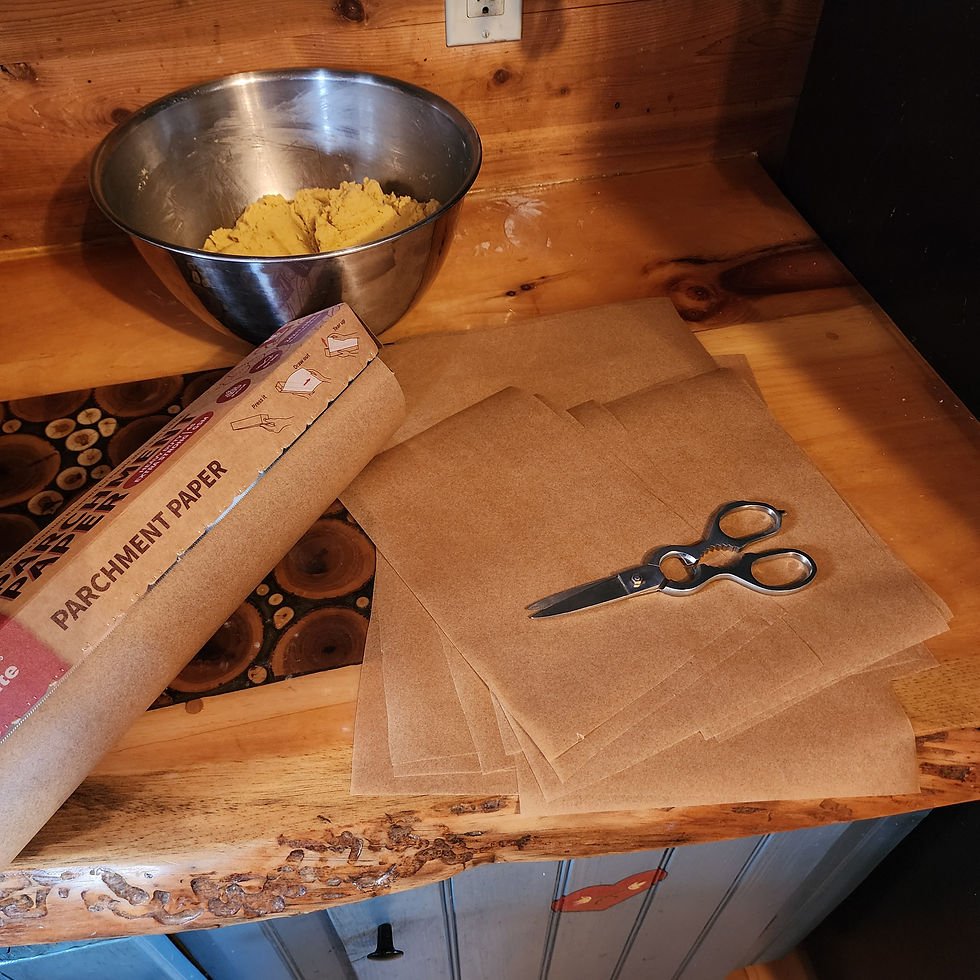
Prepare Parchment Paper Wrappers
Cut 30 sheets of 9" x 7" parchment paper wrappers.
The target size is 9 x 7 inches, but if yours are off by a little because of the size parchment paper you start with, don't sweat it. Anything in that neighborhood will be good enough. My roll is 15 inches wide, so I cut fifteen 9 inch long sheets and cut them in half for a total of thirty 9 x 7.5 inch sheets.
Begin Assembling Tamales

Put a large pot (at least 3 gallons) with a rack in the bottom, and hot water up to the rack, on the stove and turn to low.
You may feel like all thumbs for the first couple tamales that you make, but you will have the hang of it in no time!
The goal is to smear masa on the sheet in a layer about 1/4" thick, butting up to one long edge of paper, and with a 3" margin on the other three sides.
Take a spatula and scoop up about a quarter cup of dough and begin smearing down a square of masa. It will not be perfect, just get it close enough. You may need more dough or you may get rid of some, depending on how wide and thick you smear the dough.
Once the masa is on, take a spoonful of meat filling and lay it down the center of the masa, parallel to the long edge.

Now roll the tamale. Grab the edge with the dough and lift it, folding it loosely over so that the edge comes in contact with the opposite side of the masa. Tuck it in a little to squeeze the masa edges together. Finish rolling, then fold over the two ends so that it creates a neat little packet.
Place the wrapped tamale on end in the pot, on the rack above the water.
Continue assembling tamales until you run out of meat or dough. Stack them all in the pot side by side.
Put on the lid. Turn the heat up so that it comes to a simmer and let it steam for an hour. Check on it occasionally and add water if needed.
The tamales are done when the paper comes cleanly off the masa.
Tamales can be assembled and frozen to be cooked later.



Comments